
Taking a Mental Health Day From Work
A mental health day work absence is a planned day off specifically to rest, recover, and protect your psychological well-being. It is not a sick day where you pretend to have the flu. It is not a vacation day spent running errands.
It is a deliberate pause — a recognition that your brain, like your body, sometimes needs rest to function.
If taking a mental health day feels indulgent or scary — if you hear your inner critic saying “other people manage, why can’t you” — you are not weak. You are living in a culture that treats exhaustion as a badge of honor and then wonders why everyone is burned out. your roadmap to workplace burnout complete guide
A many2 survey by the American Psychological Association found that 81% of workers said they would be more likely to stay at a company that offered mental health support, yet only 38% felt comfortable actually taking a mental health day when they needed one. The need is enormous. The stigma is the barrier.
Important: A mental health day is a preventive measure. It is most effective when taken before you reach a breaking point — not after. The goal is to rest before you collapse, not to recover from the collapse.
Signs You Need a Mental Health Day
Many people wait until they are in crisis to take a day off. By that point, one day is rarely enough. Recognizing the early signs allows you to use a mental health day as prevention rather than triage.
- You dread going to work in a way that feels different from normal Monday reluctance
- You are irritable with coworkers or family members over small things
- You cannot concentrate — reading the same email three times and still not absorbing it
- You feel physically exhausted despite adequate sleep
- You are making uncharacteristic errors or forgetting important tasks
- You feel emotionally numb or disconnected
- Your body is sending stress signals: headaches, stomach issues, muscle tension
If you have three or more of these, you are not being dramatic. Your nervous system is asking for a pause.
How to Actually Take a Mental Health Day
Taking the day is the easy part. Using it effectively — so you actually feel better afterward — requires intention. Here is a framework.
Step 1: Request the Day Without Over-Explaining
You do not need to justify a mental health day with a detailed account of your emotional state. “I need to take a personal day” is sufficient. If your workplace culture is supportive, you can be direct: “I need a mental health day.” If it is not, a simple “I am not feeling well” is truthful without inviting interrogation.
Mental health is health.
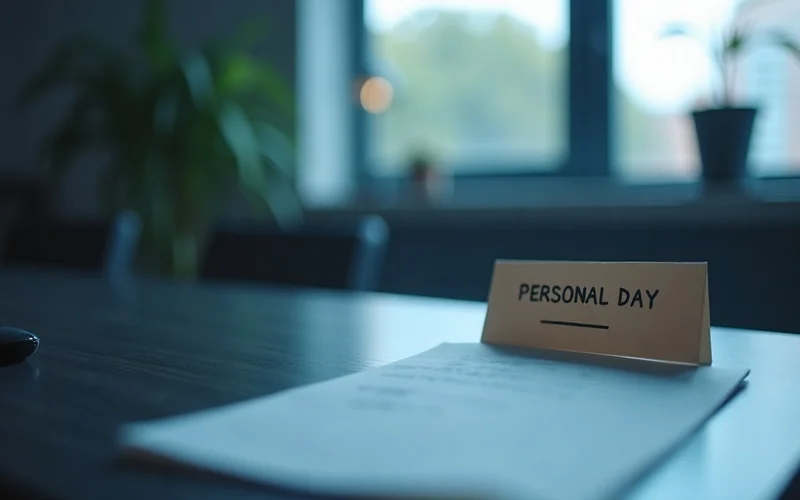
Step 2: Plan the Day Intentionally
The worst mental health day is one spent doom-scrolling in bed and feeling guilty about not being productive. That is not rest. That is anxious paralysis. Plan the day in advance:
- Morning: Sleep in without an alarm. Eat a real breakfast. Do something gentle — a walk, stretching, sitting outside.
- Midday: Do something that restores you. This varies by person. Reading. Gardening. Cooking. Calling a friend. Painting. Anything that engages you without depleting you.
- Afternoon: Process what has been building. Journal. Talk to a therapist if you have one. Identify the specific stressors that pushed you to this point.
- Evening: Wind down early. No screens. A real dinner. Go to bed early. This is part of the recovery.
Step 3: Do Not Work
This sounds obvious. It is not. The temptation to “just check email” or “just finish that one thing” is powerful. Every time you give in, you teach your brain that rest is conditional — that you have to earn it.
A mental health day is not earned. It is necessary.
A Real Example: The Day That Prevented a Breakdown
David, a 38-year-old project manager, had been running on empty for six months — tight deadlines, difficult stakeholders, and a team that kept shrinking while expectations kept growing. One Tuesday morning, he sat in his car in the office parking lot and could not make himself get out.
He called in sick. Not with a physical illness — he just told his manager he needed a personal day. Then he drove to a park, sat on a bench, and cried. He spent the rest of the day sleeping, walking, and writing down everything that was making him miserable.
That evening, he updated his resume. Not because he quit — but because giving himself permission to imagine leaving made staying feel like a choice rather than a trap.
David took three more mental health day work absences over the next six months. Each one bought him time to recover before the pressure became unmanageable. He later said: “That first mental health day did not fix my job. But it fixed my ability to see clearly what needed to change.”
What to Do If Your Workplace Does Not Support Mental Health Days
Not every workplace culture supports this. If you cannot take an explicit mental health day, you can still protect your mental health:
- Use a regular sick day. Your mental health is a valid reason to call in sick.
- Schedule a vacation day strategically — midweek is often better than a long weekend for recovery.
- If you cannot take a full day, take an afternoon. Leave at lunchtime. A half-day of rest is far better than none.
- Build micro-recovery into your workday: a real lunch break, a walk between meetings, five minutes of deep breathing between tasks.

Mental Health Days vs. Avoidance
| Mental Health Day | Avoidance |
|---|---|
| Planned intentionally to recover | Reactive escape from discomfort |
| Includes activities that restore you | Includes activities that numb you |
| You return feeling better | You return feeling the same or worse |
| Reduces long-term stress | Increases long-term stress |
| Taken occasionally and strategically | Becomes a pattern of withdrawal |
The Difference Between a Mental Health Day and Playing Hooky
One of the barriers that keeps people from taking mental health days is the internal accusation that they are just being lazy or avoiding work. This guilt is powerful, but it is based on a misunderstanding of what mental health days actually accomplish.
Playing hooky is avoidance. You skip work to do something more fun, and the underlying problem — the stress, the burnout, the overwhelm — is still there when you return. A properly used mental health day addresses the underlying problem directly. You are not escaping.
You are recovering. The distinction is not about what you do during the day. It is about the intention and the outcome.
How to Know the Difference
Ask yourself two questions. First: will this day off improve my ability to function when I return? If the answer is yes — if rest, reflection, or recovery will genuinely restore your capacity — it is a mental health day. Second: am I addressing the root cause or just postponing it?
If you are using the day to process stress, see a therapist, or make a plan to change what is draining you, it is a mental health day. If you are using it to binge-watch Netflix and pretend Monday will not come, that is avoidance.
Returning After a Mental Health Day
The return matters as much as the day itself. Do not try to cram five days of work into four to compensate for taking one day off. That defeats the purpose. Instead, return with clear priorities.
Identify the one or two most important tasks and focus on those. Communicate briefly with your team if needed — “I was out, I am catching up, here is where I am at” — without over-explaining. You took a day to protect your mental health.
Do not undo that protection by punishing yourself for it.
Creating a Workplace Culture That Supports Mental Health
Individual mental health days are essential, but they are not a substitute for a workplace culture that supports mental health every day. If you are in a leadership position, you have the power to influence this culture. If you are not, you can still advocate for changes that benefit everyone.
What Leaders Can Do
Normalize mental health days by taking them yourself and being transparent about it. “I am taking a personal day tomorrow to recharge” sends a more powerful message than any policy document. Check in with your team members as people, not just as producers. Ask how they are doing and mean it.
Notice when someone’s performance or demeanor changes and inquire with concern rather than criticism. These are not soft skills — they are leadership skills that directly impact retention, productivity, and team cohesion.
What Employees Can Do
If your workplace does not explicitly support mental health days, you can still protect your wellbeing. Use your existing sick days — mental health is a valid reason. Build micro-recovery into your workday.
Set boundaries around email and after-hours communication. If your workplace punishes these basic acts of self-preservation, that is information about whether this job is sustainable for you long-term.
The Cost of Ignoring Mental Health at Work
The World Health Organization estimates that depression and anxiety cost the global economy one trillion dollars annually in lost productivity. Burnout, presenteeism — being physically present but mentally disengaged — and turnover are all downstream consequences of workplaces that treat mental health as an individual problem rather than an organizational responsibility.
FAQ
How often should you take a mental health day?
There is no fixed rule, but many mental health professionals recommend one to two days per quarter as preventive maintenance. If you need them more frequently, the underlying issue — workload, workplace culture, untreated mental health condition — needs to be addressed directly.
What do I tell my boss?
“I need to take a personal day” is professional and sufficient. If you have a supportive manager, “I need a mental health day” can help normalize the practice for your whole team. You are not obligated to disclose details.
What if I feel guilty taking a mental health day?
Guilt is normal but misdirected. You are not letting anyone down by resting. You are preventing the burnout that would actually let people down — the kind where you cannot work for weeks or months instead of one day.